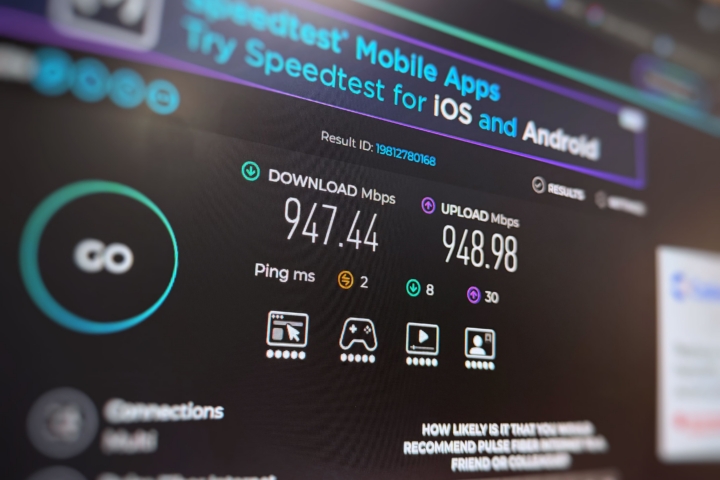
Symmetrical internet speeds explained
Symmetrical internet means your upload speed matches your download speed, so a 1 Gig plan gives you 1 Gig down and 1 Gig up. If your internet feels fast until you try to send something, uneven speeds are usually the reason. Video calls freeze, uploads are slow, and that “high-speed” plan suddenly doesn’t feel so speedy.
Pulse Fiber Internet delivers symmetrical speeds on every plan. Here is what that means, how it compares with cable and DSL service, and why it matters in Loveland, Timnath, and Northern Colorado.
What is symmetrical internet?
Symmetrical internet is a connection with equal upload and download speeds. This is a primary benefit for fiber internet. If you have a 1 Gig symmetrical plan (1,000 Mbps), you get 1 Gig down and 1 Gig up. Fiber networks make this possible, and it is the biggest practical difference between fiber and most cable or DSL service.
Symmetrical vs asymmetrical internet
Most traditional plans are asymmetrical, which means download speeds are far higher than upload speeds. A plan might advertise 500 Mbps but deliver only 20 Mbps of that when you’re sending data instead of receiving it.
| Broadband Technology | Download Speed Range | Upload Speed Range |
| Cable | 10-500 Mbps | 5-50 Mbps |
| Fiber | 250-1,000 Mbps | 250-1,000 Mbps |
| Fixed Wireless | 10-25 Mbps | 1 Mbps |
| Satellite (Geostationary) | 25 Mbps | 3 Mbps |
| Satellite (Low-earth orbit) | 100 Mbps | 20 Mbps |
Source: Raising the Minimum Fixed Broadband Speed Benchmark: Background and Selected Issues, June 12, 2021, at https://www.congress.gov/crs-product/IF11875
Upload speed vs download speed
Upload speed is how fast your connection allows data to be sent from your devices to the internet. Platforms where you are uploading images, sending large files, or streaming your own video feed will perform better with faster upload speeds.
Download speed is how fast your connection can pull data from the internet and send it to your devices. Any platform where you are downloading data, such as your email, Netflix, Spotify, or YouTube, will perform better with faster download speeds.
Both matter. Asymmetrical plans simply make one of them much smaller than the other.
Benefits of symmetrical internet
Fast uploads change how your whole household uses the internet. Here’s what you get with a symmetrical connection:
- Better remote work and online learning. Video calls stay sharp and shared screens don’t stutter.
- Support for home-based businesses. Upload product photos, host video consultations, and move big files to clients without waiting around.
- Smoother calls and gaming. Plenty of upload room keeps video calls and games from lagging when others are sending files.
- A future-proof connection. As more of what we do online involves sending data, such as cloud storage, live streaming, and smart home devices, upload speed only becomes more important.
- Great for multiple users. When several people are on video calls, gaming, and streaming at the same time, a symmetrical connection has the capacity to keep everyone connected.
Ready to see what symmetrical speeds can do for your home? Check Pulse’s availability at your address.

Why fiber delivers symmetrical speeds (and cable and DSL don’t)
The reason why fiber can deliver symmetrical speeds and cable and DSL don’t comes down to how each network was built.
Cable networks were originally designed for TV, back when almost all data traveled in one direction: from the provider to your home. Cable providers prioritized download performance, and upload capacity was an afterthought. DSL, which runs over older phone lines, faces similar limits. Newer cable technology is improving upload speeds, but it generally still trails fiber
Fiber works differently. It sends data as pulses of light through glass strands, which allows fast speeds in both directions. Without the legacy design limits of older networks, fiber can deliver the same speed up as it does down.
Symmetrical fiber internet in Loveland, Timnath, and Northern Colorado
More people in Northern Colorado work from home, run small businesses from a spare room, and learn online. That puts real pressure on upload speed. With Pulse, whether you choose 500 Mbps or 10 Gigs, your upload speed matches your download speed.
“My service has been great. It is reassuring to feel that I can depend on my internet being available when I need to use it.” – Darell Z., Pulse customer
Ready to experience symmetrical speeds?
If you’re tired of waiting on slow uploads, it’s time to see what a true fiber connection can do. Check availability at your address and pick the speed that fits your home. Pulse makes it easy to switch internet service providers and delivers exceptional support every step of the way.
Frequently asked questions
Is symmetrical or asymmetrical internet better?
Symmetrical internet is better if you upload as much as you download, such as video calls, cloud backups, live streaming, or working from home. Asymmetrical plans can be fine for light browsing and streaming, but uploads are the first thing to slow down when several people are online.
Is 1 Gig symmetrical fast enough for a family?
For most families, yes. A 1 Gig symmetrical connection leaves plenty of room for several video calls, streaming, gaming, and cloud backups at the same time. Larger households with heavy usage can choose a faster Pulse plan.
Is symmetrical internet worth it?
If more than one person in your home is on video calls, gaming, or uploading at the same time, symmetrical internet is worth it. Everyone gets a smooth connection, even when the whole household is online.
Is fiber internet always symmetrical?
Not always. Some fiber providers sell plans with slower uploads, but every Pulse plan is symmetrical.
Is symmetrical internet better for gaming?
Upload speed keeps voice chats clear and helps if you live stream your games. A fiber connection also typically has lower latency, helping with gaming performance.
Does symmetrical internet cost more?
Not with Pulse. Symmetrical speeds come standard on every plan.