
The Power of Choice: Subscriber or not, Pulse drives down costs
Publicly owned internet has been a financial game-changer for our community, potentially saving Loveland residents $30–60 million over the past four years, whether they subscribed to Pulse or not. By establishing a local fiber-optic internet option, the city has not only created an option for affordable, reliable service but also sparked competition, driving down prices across the board. Assuming a modest average decrease of between $10 and $20 per month for residential internet costs due to competition, the total savings for Loveland residents could amount to $30-60 million. This community-driven effort has helped to keep more money in our pockets.
More Internet Bang for Your Buck
Feeling like your bill hasn’t decreased, especially when costs for everything are rising everywhere? The increase in competition may have mitigated inflation pressures, or you might be getting faster service (more Mbps!) for the same price. Internet plans are typically based on speed, with options like 500 Mbps or 1 Gig (1,000 Mbps) plans. The speed you need depends on factors such as the number of people or devices using the internet.
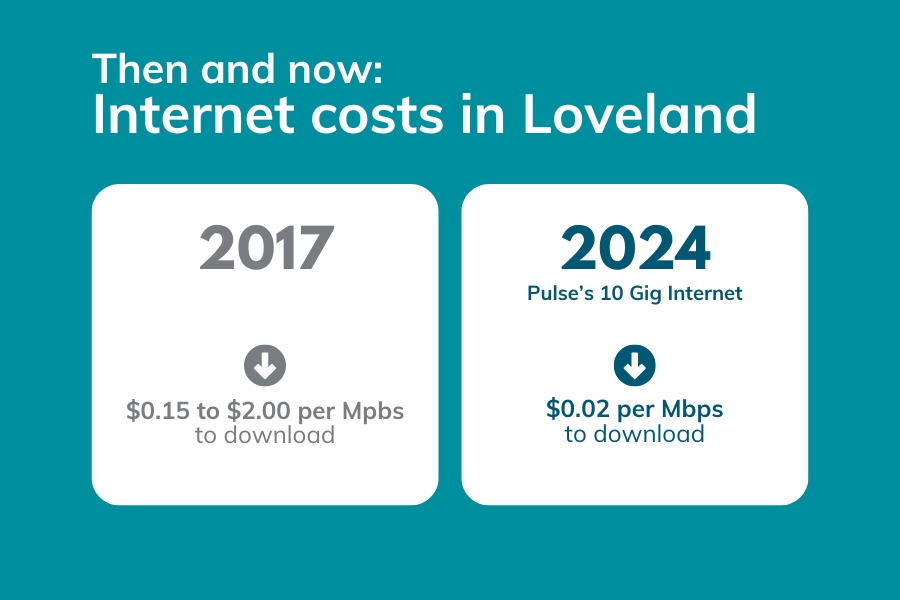
The cost per Mbps has seen a dramatic decline. In 2017, Loveland households paid between $.15 and $1.00 per Mbps of download speed. Currently, in 2024, Pulse’s Pro plan offers 10 Gigabits (10,000 Mbps) of symmetrical internet – meaning upload and download speeds are the same – at $0.02 per Mbps. Other providers’ prices have also fallen into the ranges of $0.07 to $0.43 per Mbps.
Additionally, as a city-owned enterprise, revenue received from services provided is continually reinvested to pay for operations and maintain our future-proofed infrastructure, further enhancing service quality and reliability. This model keeps more money in our community’s pockets, supports our local economy, creates jobs, and fosters a sense of unity and pride.
Pulse has not only contributed to significant financial savings but also improved the standard of living by ensuring everybody is able to reliably connect to work, study, access healthcare, and play online.
The goal of community-owned internet has always been to provide the highest quality, affordable internet service as a choice for the entire community. Four years after Pulse subscribed its first customer on June 22, 2020, this goal has been achieved. Capital network construction past every home and business in the city was completed just 48 months after it began, and the network has been recognized as a national leader in quality and reliability. According to PCMag Pulse was the second fastest ISP in the United States in 2023, and it is the Best Gaming Quality Network in the nation in 2024.

We are proud to deliver 99.95% network uptime with outstanding customer experiences, and that the power of choice has saved our entire community real money at the individual household level.
Want to learn more about how Pulse will make your digital life better in every way? Give us a call at 970-541-4990 or visit us at our new location at Forge Campus in Loveland at 815 14th Street SW, Suite C240.
Best WiFi Settings for Gaming
If you game online, you already know how fast things can fall apart when your connection isn’t living up to your ISP’s promises. A few extra milliseconds of latency, a burst of jitter, or some packet loss, and suddenly you’re fighting your WiFi instead of the other team.
This guide is here to fix that. We’ll walk through how to optimize WiFi for gaming, starting with the real-world stuff people usually ignore, then moving into the router settings that actually matter. By the end, you’ll know what to tweak, how to test it, and how to keep your setup stable so you can focus on winning.
Understanding WiFi Fundamentals for Gaming
Before you start flipping switches in your router, it helps to understand what’s actually going on under the hood. These basics explain why some setups feel rock-solid while others never quite do, even when the speed test looks fine.
Frequency bands matter, but context matters just as much.
2.4 GHz generally travels farther and pushes through walls better, but in many neighborhoods it’s crowded with nearby networks and household devices. That makes it reliable for low-demand gear like smart lights, but often less predictable for gaming.
5 GHz usually delivers better gaming performance when you’re close enough to the router for a strong signal. It has more available spectrum and often less interference, but it doesn’t carry as well through distance and walls. If the signal drops too low, stability can suffer.
Newer WiFi standards help most when your network is busy.
WiFi 6, 6E, and 7 don’t magically lower ping on their own, but they do improve how routers manage multiple devices at once. On a busy home network, that smarter traffic handling can reduce contention and help keep latency more consistent while you play.
Channel width is a tradeoff, not a free upgrade.
Wider channels can move more data, but they’re also more vulnerable to interference and overlap with neighboring networks. In crowded environments, narrower channels often deliver more reliable performance, even if headline speeds are lower.
Wider channels tend to work best only when the surrounding airspace is relatively clean.
Efficiency features help, but they aren’t silver bullets.
Technologies like MU-MIMO and beamforming can improve overall network efficiency and help maintain stronger links in the right conditions, especially when multiple devices are active at once.
For gaming, they’re supporting factors rather than the main driver of low latency and smooth play.
1. Speed Matters
Speed is the part everyone fixates on first, and for good reason. Online games are constant conversations between your device and the game server. Every movement, shot, ability, and voice chat packet has to get out quickly and come back just as fast. When your download speed is too low, game updates crawl, textures load late, and background traffic can choke the connection. When upload speed is lacking, your inputs, voice chat, and state updates struggle to leave your network cleanly, which can show up as delayed actions or desynced moments in fast-paced matches.
Higher speeds create breathing room. They give your network headroom so a background download, a stream in another room, or a cloud sync doesn’t immediately spill over into your gaming traffic. That extra capacity reduces the odds that packets pile up and wait their turn, which is when latency and jitter start creeping in. For competitive games especially, having enough upload bandwidth is critical, since you’re constantly sending small but time-sensitive packets upstream. Symmetrical connections shine here because they treat those upstream packets with the same priority as downstream data.
That said, speed works best when it supports a stable foundation. Raw megabits don’t automatically translate into smooth gameplay if the signal is weak, interference is high, or the network is mismanaged. Think of speed as the ceiling of what your connection can handle. A higher ceiling gives you flexibility and resilience, especially in busy households, but the consistency of how data flows beneath it is what determines whether a match feels responsive or frustrating.
2. How to Optimize WiFi for Gaming (Before Touching Settings)
Even the best router settings won’t save you if the basics are off. Start here.
First, your internet connection itself matters. Cable or fiber with low advertised latency is ideal. DSL and satellite tend to introduce delays you can’t tune away.
Next, router placement. This sounds boring, but it’s huge. Put the router somewhere central and a bit elevated. Don’t shove it behind a TV or next to a metal cabinet.
Cut down interference where you can. Microwaves, cordless phones, and random Bluetooth gear all add noise. Also, don’t let cloud backups or big downloads run while you’re gaming.
If your router supports it, separate your gaming devices onto their own SSID or VLAN so they aren’t competing with everything else.
And if you use mesh, always opt for wired backhaul between nodes. Alternatively, give our Plume WiFi+ Suite or Adaptive WiFi+ a try for a reliable way to extend your WiFi.
3. Best WiFi Router Settings for Gaming
Note: With Pulse, you don’t have to worry about any of this, since you won’t have a router unless you buy your own and use bridge mode (or have the two-box solution). You’ll already be set up for the best possible WiFi experience without altering settings.
Once your physical setup is in good shape, router tuning is about improving consistency, not performing miracles. These tweaks matter most when your home network gets busy or crowded, and they won’t override weak signal, heavy interference, or ISP-side issues.
Start with band choice, not blind band steering.
If your router supports it, nudging capable devices toward 5 GHz can help, but only when the signal is strong. In rooms far from the router or behind multiple walls, 2.4 GHz may actually be more reliable. Some networks work better with separate 2.4 and 5 GHz names instead of aggressive band steering, so stability matters more than forcing a band.
Choose channels intentionally, but understand the limits of scanners.
A WiFi analyzer is better than guessing, but it only shows nearby WiFi networks, not all sources of interference. Use it to avoid obvious congestion, then validate stability over time rather than assuming a channel is “perfect.”
Use DFS channels selectively.
DFS channels can be very clean in some areas, but they carry a tradeoff: if radar is detected, your router must move channels, which can cause brief disconnects. If you notice unexplained drops, standard 5 GHz channels may be the safer choice.
Treat channel width as a reliability dial, not a speed knob.
On 5 GHz, 40 MHz often delivers the most consistent performance in busy neighborhoods. 80 MHz can work well when interference is low. Reserve 160 MHz for rare environments where congestion is minimal and stability has been tested over time.
Manage congestion carefully instead of relying on generic Quality of Service (QoS).
Prioritizing a gaming device only helps when your connection is actually saturated. Many consumer QoS systems are crude, and poorly tuned rules can add delay instead of removing it. If your router supports smart queue management or anti-bufferbloat features, those are often more effective at keeping latency steady under load.
Be cautious with airtime fairness and advanced features.
WiFi Multimedia (WMM) should stay enabled, as it’s required for modern WiFi performance. Airtime fairness can improve efficiency on some networks, but it can also cause compatibility issues with certain devices. If you see instability after enabling it, turning it off is a valid move.
Adjust transmit power with intent.
Maxing out transmit power isn’t always better. In multi-room or mesh setups, excessive power can increase interference and cause devices to cling to distant access points. Use only as much power as your space actually needs to maintain a clean signal.
Handle port forwarding and UPnP only when necessary.
These features don’t improve WiFi quality on their own and should be enabled only if a specific game or service requires them, and with care.
These settings won’t rescue poor WiFi, but when your signal and placement are already solid, they can make performance more predictable and keep your connection steady when it matters most.
4. Troubleshooting Common WiFi Gaming Problems
Problems still happen. When they do, slow down and diagnose first.
High latency usually means congestion or interference. Try a different channel, move to 5 GHz, and double-check QoS.
Packet loss often points to bad links. Reseat cables, update drivers, and check antenna placement, especially on mesh nodes.
Jitter spikes are often caused by legacy devices dragging the network down. Disabling old 802.11b/g rates and enabling airtime fairness can help.
Firmware bugs are real. If things break after an update, rolling back is sometimes the best move.
If peak-hour congestion keeps ruining matches, isolate traffic or reschedule background activity.
Final Thoughts on Optimizing Your WiFi for Gaming
Optimizing WiFi for gaming isn’t about one magic setting. It’s about stacking small, sensible improvements until your connection feels boring, in a good way.
Start with placement and interference, dial in your router settings, then test and adjust over time. Make changes one at a time and keep what actually helps. If you want to go further, explore router config templates, monitoring dashboards, or custom firmware for deeper control.
If you’re in Larimer County, and need the best WiFi for Gaming, look no further. Pulse was ranked #1 by PC Mag in 2025 and 2026 for a reason; we offer high, symmetrical speeds that are perfect for gamers.